
Crypto Scalping Strategy for NSE: High-Frequency Trading Guide
If you're serious about intraday trading on the NSE, you've likely heard the term "scalping" thrown around. Crypto scalping represents one of the most intense but potentially rewarding momentum strategies available to active traders. Unlike swing trading or position trading, scalping demands real-time focus and rapid decision-making—but the trade frequency and defined risk structure attract traders looking for consistent, bite-sized opportunities.
This guide walks you through how crypto scalping works on NSE charts, how to identify entry and exit signals, and when this strategy makes sense for your trading plan.
What Is Crypto Scalping?
Crypto scalping is an intermediate-level momentum strategy designed to capture small, rapid price movements over very short timeframes—typically 1-minute and 5-minute charts. The objective is simple: enter a position when price action and volume signal the start of a micro-trend, hold for seconds to minutes, and exit with a small profit before momentum fades.
Unlike day trading, which might hold positions for 15–60 minutes, scalping closes positions almost immediately. Each trade targets a modest return—often just ₹10–50 per share depending on the stock's volatility and your position size. The edge comes from high trade frequency: if you can execute 20–40 trades per session with a positive win rate, compounding these small wins creates meaningful daily returns.
The trade-off? Scalping requires:
- Full-time screen attention during market hours
- Strict emotion management and rapid execution
- Tight stop losses and defined risk on every entry
- Low slippage (liquid stocks only)
How Crypto Scalping Works on NSE Charts
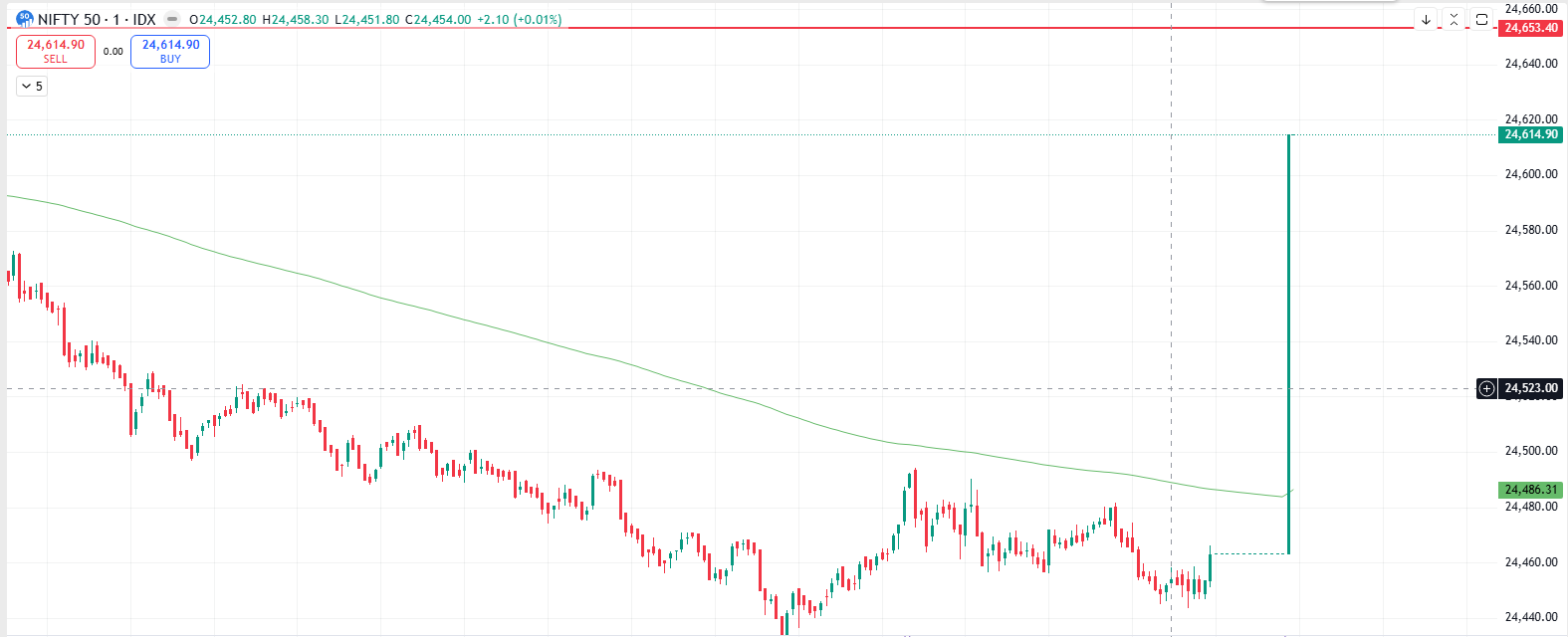
On the NSE, crypto scalping exploits the micro-volatility that exists in high-liquidity segments—especially in index derivatives and volatile cash stocks. The 1-min and 5-min timeframes are where this volatility becomes visible.
Price action on these timeframes is choppy and noisy. Your job as a scalper is to filter that noise using volume confirmation. When price makes a new high or low on the 1-min chart but volume is weak, it's often a false move. When price moves with expanding volume, it signals genuine momentum from institutional or algorithmic traders.
The NSE's tight bid-ask spreads and deep liquidity (especially in Nifty 50 stocks and indices) make scalping viable. You can enter and exit without significant slippage, preserving your razor-thin profit margins.
Entry and Exit Rules
Entry Signal:
- Price breaks above a recent 1-min or 5-min high with volume above the 5-bar average
- Or price holds above a key support level with bullish candle close and volume confirmation
- Look for breakouts from consolidation zones (tight 2–3 candle ranges)
- Always define your stop loss before entry—typically 1.5x the recent bar range or 0.3–0.5% of entry price
Exit Signal:
- Take profit: when price reaches your pre-set target (2:1 or 3:1 risk-reward ratio minimum)
- Stop loss: if price closes below your stop level
- Time-based exit: if no momentum appears after 3–5 minutes, close the position regardless of profit/loss
- Volume divergence: if price rallies but volume dries up, exit immediately (sign of fading momentum)
When to Use Crypto Scalping
This strategy works best during high-volatility market windows:
- Market open (9:15–10:00 AM IST): Maximum volatility and volume on NSE
- Index futures rollover days: Price swings are exaggerated
- Economic data releases: Sudden volatility spikes create scalping opportunities
- Post-lunch hour (1:00–2:30 PM): Secondary volatility wave
Avoid scalping during low-volume periods (late afternoon) or when spreads widen (e.g., during unexpected news).
Common Mistakes to Avoid
Overtrading: Just because you can execute 50 trades doesn't mean you should. Only take high-conviction setups with clear volume confirmation.
Ignoring stop losses: Scalping only works if you honor your defined risk. One unmanaged loss can wipe out 20 winning trades.
Scalping illiquid stocks: Wide spreads and slippage will kill your edge. Stick to Nifty 50 stocks or index futures.
Chasing momentum: If you miss an entry signal, don't chase. Wait for the next setup. FOMO causes losses.
Conclusion: Test Your Strategy First
Crypto scalping is a legitimate NSE strategy—but only if you have the discipline, liquidity, and tools to execute it properly. Before risking real capital, backtest your entry and exit rules on historical data to validate your approach.
Momentum IQ's strategy research platform lets you backtest crypto scalping and other momentum strategies across NSE data with precise price action and volume filters. You can optimize your stop loss levels, profit targets, and entry criteria in minutes—and see exactly how your strategy would have performed. Start testing your scalping edge today and trade with confidence.
Try it yourself: Crypto Scalping
Run this exact strategy on any NSE stock with your own parameters.
More in Strategy Guides
Auction Market Theory for NSE: A Beginner's Price Action Guide
Pivot Bounce Strategy for NSE: A Beginner's Guide
Pin Bar Strategy for NSE: A Beginner's Guide to Price Action Trading
Artificial Intelligence Trading Strategy for NSE Markets