
Scalping with DOM: NSE Intraday Strategy Guide
If you're an active NSE trader looking for a structured approach to capture small, consistent price moves throughout the trading day, scalping with DOM (Depth of Market) deserves your attention. This intermediate-level strategy combines price action analysis with volume insights to identify high-probability entry points on ultra-short timeframes.
Unlike swing or positional trading, scalping demands discipline, real-time focus, and a clear mechanical ruleset. When executed properly, it can generate multiple trade signals per hour across liquid NSE stocks and indices.
What Is Scalping with DOM?
Scalping with DOM is a momentum-driven intraday strategy that targets rapid price movements on 1-minute and 5-minute charts. The strategy leverages two core elements:
- Price Action: Real-time observation of support, resistance, and breakout behavior
- Volume: DOM analysis to gauge buyer/seller imbalance and trend strength
The DOM (or Level 2 data) shows buy and sell orders stacked at different price levels. By watching where volume clusters and how orders flow, scalpers can anticipate directional bias before the move occurs. Combined with clean price action, this gives traders a statistical edge on very short timeframes.
This strategy is not for casual traders. It requires full-time screen attention, quick decision-making, and emotional discipline. But for those willing to commit, it produces high trade frequency with defined, manageable risk on each entry.
How It Works on NSE Charts
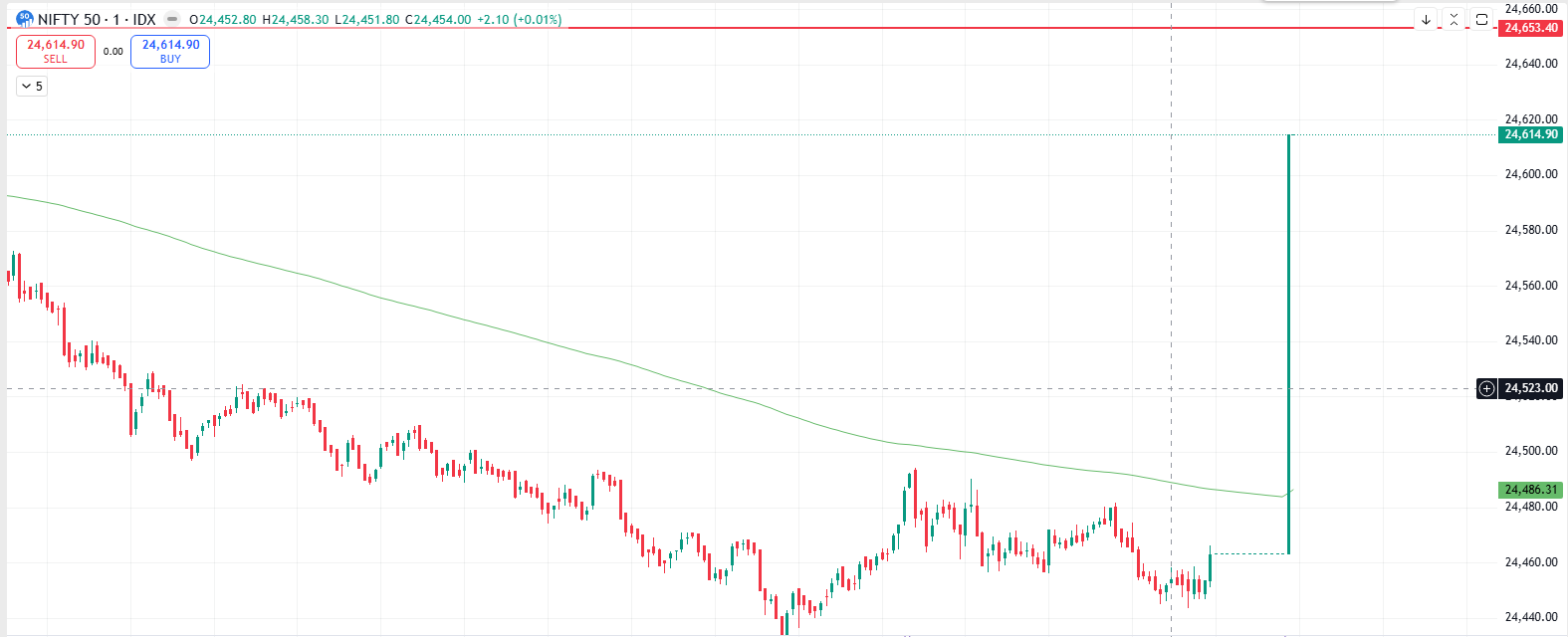
On NSE 1-min and 5-min charts, price moves in waves and micro-trends. Scalping with DOM exploits these waves by:
- Identifying micro support and resistance levels using recent swing highs/lows
- Observing DOM to confirm volume accumulation or distribution at key prices
- Triggering entry signals when price action breaks structure with matching volume
- Exiting quickly—typically within 5 to 15 candles—for small but repeatable gains
The key insight: on short timeframes, large institutional orders often show up in the DOM before they execute. Smart scalpers use this visible liquidity to confirm their price action thesis before risking capital.
Entry and Exit Rules
Entry Signals
Look for entry signals when:
- Price breaks a recent micro swing high or low on volume
- DOM shows aggressive buying/selling at the breakout level (order flow confirmation)
- The entry candle closes beyond the breakout with volume above the 5-candle average
- Risk (distance to stop-loss) is clearly defined and fits your position size
Exit Signals
Exit rules keep losses small and profits booked:
- Profit target: Historically, 1.5x to 3x the initial risk, depending on the stock and period tested
- Stop-loss: Place below the entry breakout level or recent swing low
- Time-based exit: If no profit target is hit within 15–20 candles, close the trade to avoid whipsaw
- DOM reversal: If order flow suddenly flips (large sell orders appear after a buy entry), exit immediately
When to Use This Strategy
Scalping with DOM works best during:
- Market open (9:15–10:00 AM IST): Highest volatility and volume on NSE
- Around key data releases or events: Sharp, directional moves attract scalpers
- Liquid stocks and index futures: Nifty 50, Bank Nifty, and high-volume individual stocks
- Trending days: When the market has clear directional bias
Avoid this strategy during low-volume periods (mid-morning lull, late afternoon) or on choppy, sideways days—false breakouts drain capital quickly.
Common Mistakes to Avoid
Even experienced traders stumble on scalping. Watch out for:
- Over-trading: Taking every breakout instead of waiting for high-conviction setups
- Ignoring stop-losses: Hoping for recovery after a bad entry ruins your day
- Chasing entries: Entering after price has already moved significantly; wait for a pullback
- Misreading DOM: Confusing spoofing (fake orders) with real volume; focus on actual filled trades
- Poor position sizing: Risking too much per trade; keep it small and scale up after wins
Conclusion
Scalping with DOM is a mechanical, high-frequency strategy for serious NSE traders who thrive in fast-paced environments. It's not passive—you'll need real-time focus and the discipline to follow your rules consistently. But when backtested and refined on historical NSE data, it can produce multiple trade signals per session with defined risk and repeatable outcomes.
Ready to test this strategy on actual NSE data? Head to Momentum IQ and backtest Scalping with DOM across different stocks, timeframes, and market conditions. You'll see exactly how it performs on your instrument of choice and adjust the entry/exit logic to fit your style. Start backtesting today and build confidence before you scale live.
Try it yourself: Scalping with DOM
Run this exact strategy on any NSE stock with your own parameters.
More in Strategy Guides
Auction Market Theory for NSE: A Beginner's Price Action Guide
Pivot Bounce Strategy for NSE: A Beginner's Guide
Pin Bar Strategy for NSE: A Beginner's Guide to Price Action Trading
Artificial Intelligence Trading Strategy for NSE Markets