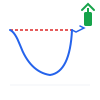
Trades the breakout from a defined consolidation or key level with volume confirmation. Well-suited for NSE where breakouts from established ranges produce reliable directional moves.
Complexity
Beginner
Easy to implement
NSE Suitability
High
9.2 / 10 score
Timeframe
Daily
Short to medium term
Best For
Beginner Traders
15–45 days moves
Indicators Used
1
Volume
Win Rate (Backtest)
11.1%
Below 50% threshold
Avg Return / Trade
-0.28%
Per trade, after costs
Max Drawdown
-3%
Within typical range
Trades / Year
9
Small sample — interpret with caution
About the Cup Base Breakout Strategy
# Cup Base Breakout
The Cup Base Breakout strategy captures the price consolidation and reversal pattern that forms when a stock builds a rounded bottom or cup-shaped base before breaking higher. This pattern typically reflects accumulation by informed buyers, and the breakout represents entry of fresh momentum. The strategy works well on the NSE because Indian equities often experience extended consolidation phases in mid-cap and small-cap segments before directional moves, and volume confirmation during breakouts tends to be reliable across both the equity and futures markets.
The setup looks for a stock that has declined, then spent several weeks to months forming a wide, bowl-shaped base without breaking below the initial support level. The trader waits for volume to expand above average as price closes above the cup's rim or resistance level. Entry typically occurs on this breakout close or the following day if momentum sustains. The strategy applies well to the NSE's trading hours and overnight holding patterns, making it suitable for daily timeframe traders who can monitor the Indian market session and set alerts for volume-confirmed breakouts. Position sizing and stop placement below the base support are essential risk management elements.
Who This Strategy Is For
This Beginner strategy suits Beginner Traders comfortable with a Daily timeframe and holding periods around 15–45 days. It's built for the Equity, Futures segment on NSE, so it fits traders who can check positions without needing intraday execution speed. Because it uses a small, well-known set of indicators, it's a reasonable starting point if you're new to systematic NSE trading.
Equity Curve (Backtest)
HIGH QUALITY
Tested on: KOTAKBANK
· 2024-05-13 to 2026-06-30
Total Return
-2.6%
CAGR
-1.3%
Sharpe Ratio
-1.11
Sortino Ratio
-1.67
Calmar Ratio
-0.43
Win Rate
11.1%
NSE Market Fit
9OUT OF 10
Very High Fit
This strategy is well-suited for current NSE market conditions.
Win rate quality Needs Caution
Risk-adjusted return Needs Caution
Drawdown control Excellent
Trade frequency (sample size) Needs Caution
Sharpe ratio Needs Caution
Monthly Returns Heatmap
2024
2025
2026
Jan
—
—
-0.1%
Feb
—
—
—
Mar
—
—
—
Apr
—
—
—
May
—
—
—
Jun
—
-0.6%
—
Jul
—
—
—
Aug
-0.4%
—
—
Sep
+0.2%
-0.5%
—
Oct
-0.7%
—
—
Nov
—
—
—
Dec
-0.6%
—
—
Positive return Negative return
Performance vs Nifty 50
Nifty 50 comparison isn't available for this backtest period yet.
Cup duration 6–16 weeks — not too shallow or too long
Cup depth between 15–35% — not more than 40%
Handle is tight — less than 15% depth
Volume extremely high on handle breakout — 3x+
Stock is a market leader in its sector
How This Strategy Works
1
Identify a consolidation zone — price must have been ranging for at least 5 sessions with defined support and resistance
2
Wait for a breakout candle closing beyond the level on volume 1.5× the 20-day average
3
Enter at the close of the breakout candle or the open of the next — stop below the breakout level, target is the measured move
Entry & Exit Rules
✓ Entry Conditions
Cup duration 6–16 weeks — not too shallow or too long
Cup depth between 15–35% — not more than 40%
Handle is tight — less than 15% depth
Volume extremely high on handle breakout — 3x+
Stock is a market leader in its sector
✕ Avoid When
Cup depth more than 50% — too damaged
Handle retraces more than 50% of the cup — weakness
Volume absent on breakout — no institutional participation
Market in correction — even strong patterns fail
Very long cup of 6+ months in small/mid-cap — operator risk
Risk Management Rules
Risk Per Trade
1.5%
of total capital
Min Capital
₹50,000
Hold Period
15–45 days
Segment
Equity, Futures
Common Mistakes to Avoid
⚠️ Breakout strategies are prone to false breakouts and whipsaws, especially around low-volume sessions or just before major news/results. Confirm volume alongside the price breakout rather than trading the level alone.
Full Backtest Report
Backtested on KOTAKBANK ·
2024-05-13 to 2026-06-30 ·
Capital ₹100,000
Equity Curve
Live tracking coming soon
We're building forward-tested, paper-trade tracking for this strategy so you can see how it performs
on live NSE data — not just historical backtests. Check back soon.
Sample Trade Walkthrough
SUPREMEIND2024-01-22 · Long
WIN
Entry ₹
₹4,650.00
Stop Loss ₹
₹4,380.00
Target ₹
₹5,190.00
Exit ₹
₹5,188.00
Supreme Industries formed a 9-week cup with depth of 22% (₹4,200 to ₹5,280 prior high, cup bottom ₹4,200). Handle formed over 6 sessions with volume drying up. On Jan 22, broke above handle high ₹4,600 with 3.2x volume. Plastics sector performing well. Entered ₹4,650. Stop ₹4,380. Target based on cup depth ₹1,080 projected = ₹5,680. Partial exit at ₹5,188.
Strategy Parameters
The exact rules and default values this strategy uses — adjust them when you run a full backtest.
Parameter
Default
Min
Max
Type
Description
cup_bars
25
15
60
integer
Minimum bars in the cup formation
cup_depth_pct
15.0
5.0
40.0
decimal
Max depth of cup as % of price
handle_bars
5
3
20
integer
Bars in handle consolidation
volume_mult
2.0
1.5
5.0
decimal
Volume spike required
atr_mult
1.5
0.5
3.0
decimal
Stop below handle low
rr
3.0
1.5
6.0
decimal
Cup gives larger targets
Frequently Asked Questions
Cup Base Breakout specifically focuses on trading the breakout from the cup formation itself, sometimes without waiting for a full handle to develop. It is a more aggressive variant of cup and handle trading, entering on the cup's right-side resistance break with the expectation that a handle may or may not form before continuation.
A quality cup base shows a smooth, U-shaped (not V-shaped) recovery from the cup low back to the cup's starting high, formed over at least 7-15 weeks on weekly charts. Volume should decline through the cup's decline phase and gradually increase as price recovers toward the prior high.
Entering at the cup's rim breakout without a handle pullback often means buying at a local high with less favorable risk-reward compared to waiting for a handle's pullback entry. However, it captures the move earlier if the stock does not form a handle and continues directly higher.
Stop loss typically goes below the cup's right-side low (the most recent swing low before the breakout) or at a percentage-based level (5-8% below entry) for growth stock trading. The wider stop reflects the longer-term nature of cup formations compared to shorter intraday patterns.
Related Strategies
Looking for alternatives? Opening Range Breakout (ORB) is a similar Beginner strategy in the same Breakout category, with High NSE suitability.
MomentumIQ is an educational platform for strategy research and backtesting. We do not provide investment advice, recommendations, or tips. All backtest results are hypothetical, based on historical data, and for educational purposes only. Past performance is not indicative of future results. Backtested results may not account for brokerage, slippage, taxes, or other real-world costs. Please consult a SEBI-registered investment advisor before making any investment decisions.
 Navigation