Intermediate★ Very High NSE Fit1-Min / 5-Min9/10 Popularity
A intermediate scalping strategy targeting small, rapid price moves on NSE intraday charts. Requires full-time screen attention but produces high trade frequency with defined risk on each entry.
Complexity
Intermediate
Easy to implement
NSE Suitability
Very High
9.2 / 10 score
Timeframe
1-Min / 5-Min
Short to medium term
Best For
Full-time Scalpers
Intraday moves
Indicators Used
1
RSI
Win Rate (Backtest)
11.1%
Below 50% threshold
Avg Return / Trade
-0.28%
Per trade, after costs
Max Drawdown
-2.5%
Within typical range
Trades / Year
9
Small sample — interpret with caution
About the Mean Reversion Scalping Strategy
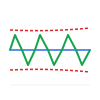
Mean Reversion Scalping exploits the tendency of prices to snap back after sharp, brief moves away from fair value. On the NSE, this is particularly effective during high-liquidity sessions when retail and institutional volume spikes, creating exaggerated intrabar swings that don't hold. The strategy works best on 1-minute and 5-minute charts where these micro-reversals are visible and executable within tight spreads.
The setup relies on RSI readings at extremes—typically below 30 or above 70—signaling overbought or oversold conditions on intraday timescales. When RSI hits these thresholds on liquid NSE scrips, the assumption is that the move has overshot and equilibrium buying or selling will pull price back quickly. Scalpers enter on the reversal signal and exit within minutes, capturing 5–15 point moves depending on the instrument.
NSE equities and index futures provide sufficient volatility and tick liquidity to make this viable, though it demands discipline around position sizing and stop placement. The strategy suits traders comfortable with rapid entry and exit execution and who can tolerate the chop inherent in short timeframes.
Who This Strategy Is For
This Intermediate strategy suits Full-time Scalpers comfortable with a 1-Min / 5-Min timeframe and holding periods around Intraday. It's built for the Equity Intraday, Futures segment on NSE, so it fits traders who can check positions without needing intraday execution speed.
Equity Curve (Backtest)
HIGH QUALITY
Tested on: TCS
· 2024-05-13 to 2026-06-30
Total Return
-2.5%
CAGR
-1.3%
Sharpe Ratio
-1.36
Sortino Ratio
-2.04
Calmar Ratio
-0.52
Win Rate
11.1%
NSE Market Fit
9OUT OF 10
Very High Fit
This strategy is well-suited for current NSE market conditions.
Win rate quality Needs Caution
Risk-adjusted return Needs Caution
Drawdown control Excellent
Trade frequency (sample size) Needs Caution
Sharpe ratio Needs Caution
Monthly Returns Heatmap
2024
2025
2026
Jan
—
—
—
Feb
—
—
—
Mar
—
-0.3%
-0.3%
Apr
—
—
—
May
—
—
—
Jun
—
—
—
Jul
—
-0.6%
—
Aug
—
-0.5%
—
Sep
—
-0.5%
—
Oct
-0.4%
-0%
—
Nov
+0.1%
—
—
Dec
—
—
—
Positive return Negative return
Performance vs Nifty 50
Nifty 50 comparison isn't available for this backtest period yet.
RSI below 25 or above 75 intraday — oversold/overbought
VWAP nearby — magnetic pull for reversion
Range-bound intraday session — no strong trend
High-liquidity large-cap stock — clean mean reversion
How This Strategy Works
1
Identify the intraday trend direction using VWAP or EMA on the 1-minute or 5-minute chart
2
Wait for a pullback to the key level — enter on the first rejection candle showing momentum resumption
3
Exit at the next micro-resistance or after a fixed target of 0.2–0.5% — stop loss is tight, just below the entry candle low
Entry & Exit Rules
✓ Entry Conditions
Price at extreme Bollinger Band on intraday chart
RSI below 25 or above 75 intraday — oversold/overbought
VWAP nearby — magnetic pull for reversion
Range-bound intraday session — no strong trend
High-liquidity large-cap stock — clean mean reversion
✕ Avoid When
Trending day — mean keeps moving away
Momentum news driving the move
Very tight spread required — illiquid stocks unreliable
After 2 PM — intraday mean reversion loses effectiveness
VIX spiking — volatility disrupts mean calculations
Risk Management Rules
Risk Per Trade
0.5%
of total capital
Min Capital
₹75,000
Hold Period
Intraday
Segment
Equity Intraday, Futures
Common Mistakes to Avoid
⚠️ Mean reversion strategies lose the most money when a stock is actually trending, not ranging — the biggest mistake is applying this strategy blindly without checking whether the broader trend is against the trade.
Full Backtest Report
Backtested on TCS ·
2024-05-13 to 2026-06-30 ·
Capital ₹100,000
Equity Curve
Live tracking coming soon
We're building forward-tested, paper-trade tracking for this strategy so you can see how it performs
on live NSE data — not just historical backtests. Check back soon.
Sample Trade Walkthrough
HDFCBANK2024-03-14 · Long
WIN
Entry ₹
₹1,448.00
Stop Loss ₹
₹1,418.00
Target ₹
₹1,508.00
Exit ₹
₹1,506.00
HDFC Bank reached lower BB (2σ) on 15-minute chart at ₹1,418 by 11:30 AM, with RSI at 22 intraday. VWAP was at ₹1,472. Exhaustion hammer candle formed at ₹1,418 with 2.3x volume spike. Classic intraday mean reversion setup. Entered ₹1,448 on bounce confirmation. Stop ₹1,418. Target VWAP at ₹1,472, exceeded to ₹1,506 by 2:15 PM.
Strategy Parameters
The exact rules and default values this strategy uses — adjust them when you run a full backtest.
Parameter
Default
Min
Max
Type
Description
bb_period
20
10
50
integer
Bollinger Band period
bb_std
2.0
1.5
3.0
decimal
Bands width in std deviations
rsi_period
14
7
21
integer
RSI filter period
rsi_oversold
30
20
40
integer
RSI confirmation for long entry
atr_mult
1.5
0.5
3.0
decimal
Tight stop for mean reversion
rr
1.5
1.0
3.0
decimal
Scalping targets lower RR
Frequently Asked Questions
Mean Reversion Scalping applies mean reversion logic on very short timeframes (1-5 minute charts), entering when price makes a short-term extreme deviation from VWAP or a fast moving average, targeting a quick return to that mean level within the same session, combining the edge of mean reversion with the speed of scalping.
VWAP is the most widely used mean reference for intraday mean reversion scalping, representing the volume-weighted average price of all transactions in the current session. Price deviating 0.3-0.5% from VWAP on a large-cap NSE stock with declining momentum provides the typical mean reversion scalp setup.
Use a tight stop of 0.2-0.4% beyond the extreme (further deviation from mean) rather than targeting a specific price, since the strategy's edge depends on the deviation not continuing indefinitely. Exit immediately if the deviation extends beyond your stop rather than hoping for the eventual mean reversion.
Low-momentum, range-bound sessions with India VIX below 15, where Nifty or individual large-caps oscillate around VWAP without establishing a clear directional trend, provide the optimal environment for mean reversion scalping. High-momentum trending days should be avoided as mean reversion attempts can quickly result in large losses.
Related Strategies
Looking for alternatives? ATR Mean Reversion is a similar Beginner strategy in the same MeanRev category, with High NSE suitability.
MomentumIQ is an educational platform for strategy research and backtesting. We do not provide investment advice, recommendations, or tips. All backtest results are hypothetical, based on historical data, and for educational purposes only. Past performance is not indicative of future results. Backtested results may not account for brokerage, slippage, taxes, or other real-world costs. Please consult a SEBI-registered investment advisor before making any investment decisions.
 Navigation