Backtesting is the process of testing a trading strategy against historical market data to evaluate how it would have performed in the past. Instead of risking real money to test an idea, you apply your entry and exit rules to past price data and measure the results — profitability, risk, win rate, and more.
Backtesting answers the question: "If I had followed this strategy for the past 5 years, what would have happened?"
Why Backtesting Matters for Indian Traders
Most retail traders in India lose money. Studies consistently show that 88% of retail F&O traders lose money. One major reason is trading strategies that have never been validated — hunches, tips from social media, or strategies blindly copied from YouTube without understanding if they actually work on Indian market data.
Backtesting changes this by giving you evidence-based confidence before committing capital.
| Without Backtesting | With Backtesting |
|---|---|
| Trade based on hope or tips | Trade based on verified historical evidence |
| Discover flaws with real money | Discover flaws with historical data (free) |
| No idea of expected drawdown | Know the worst historical drawdown in advance |
| No objective performance benchmark | Clear comparison vs Nifty 50 benchmark |
| Emotional decision-making | Rules-based, emotion-free execution |
How Backtesting Works
A backtest engine replays historical price data candle by candle and applies your strategy rules:
- You define the rules — entry conditions, exit conditions, stop loss, position size
- The engine scans history — finds every moment your entry conditions were met
- Simulates trades — buys at the specified price, applies your exit rules
- Calculates results — every trade is recorded with P&L, duration, and statistics
- Shows you the summary — CAGR, Sharpe Ratio, Max Drawdown, Win Rate and more
What a Good Backtest Includes
| Component | Why it Matters |
|---|---|
| Realistic brokerage and charges | NSE has STT, transaction tax, exchange fees — these erode profits |
| Slippage allowance | You rarely get the exact price shown on the chart |
| Sufficient data (3–5 years minimum) | Must include bull, bear, and sideways markets |
| Correct execution model | Trades execute on the open of the NEXT candle, not the signal candle |
| Benchmark comparison | Results only matter relative to buy-and-hold Nifty 50 |
What Backtesting Can Tell You
- ✅ How the strategy performed on historical NSE data
- ✅ The historical maximum drawdown you would have experienced
- ✅ Average trade duration and win/loss statistics
- ✅ Whether the strategy beats the Nifty 50 benchmark
- ✅ The best and worst periods for the strategy
What Backtesting Cannot Tell You
- ❌ How the strategy will perform in the future
- ❌ Whether the strategy is profitable after live slippage
- ❌ If you will be able to follow the rules during a drawdown
- ❌ How the strategy handles market regime changes
The Backtesting Process on Momentum IQ
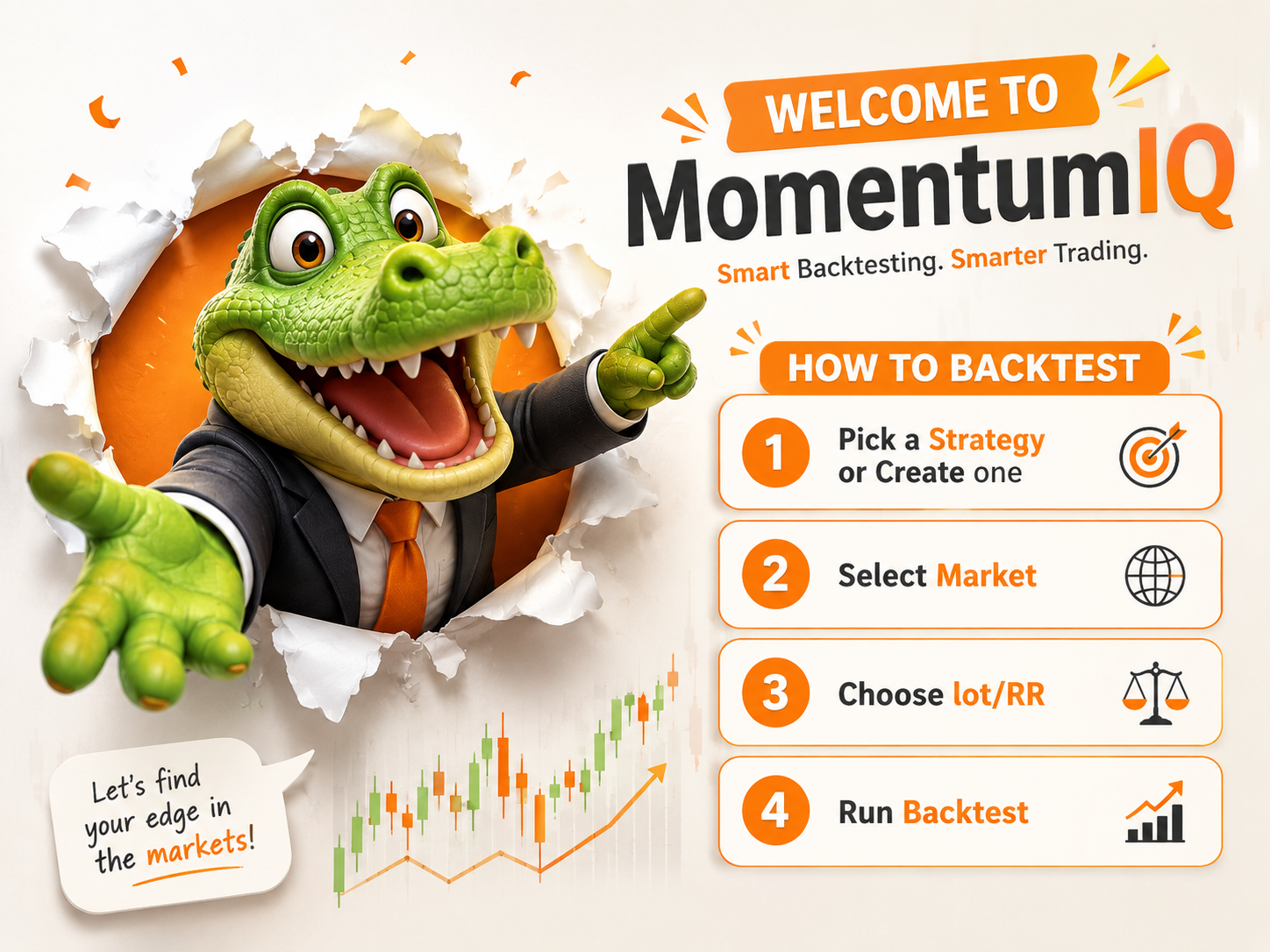
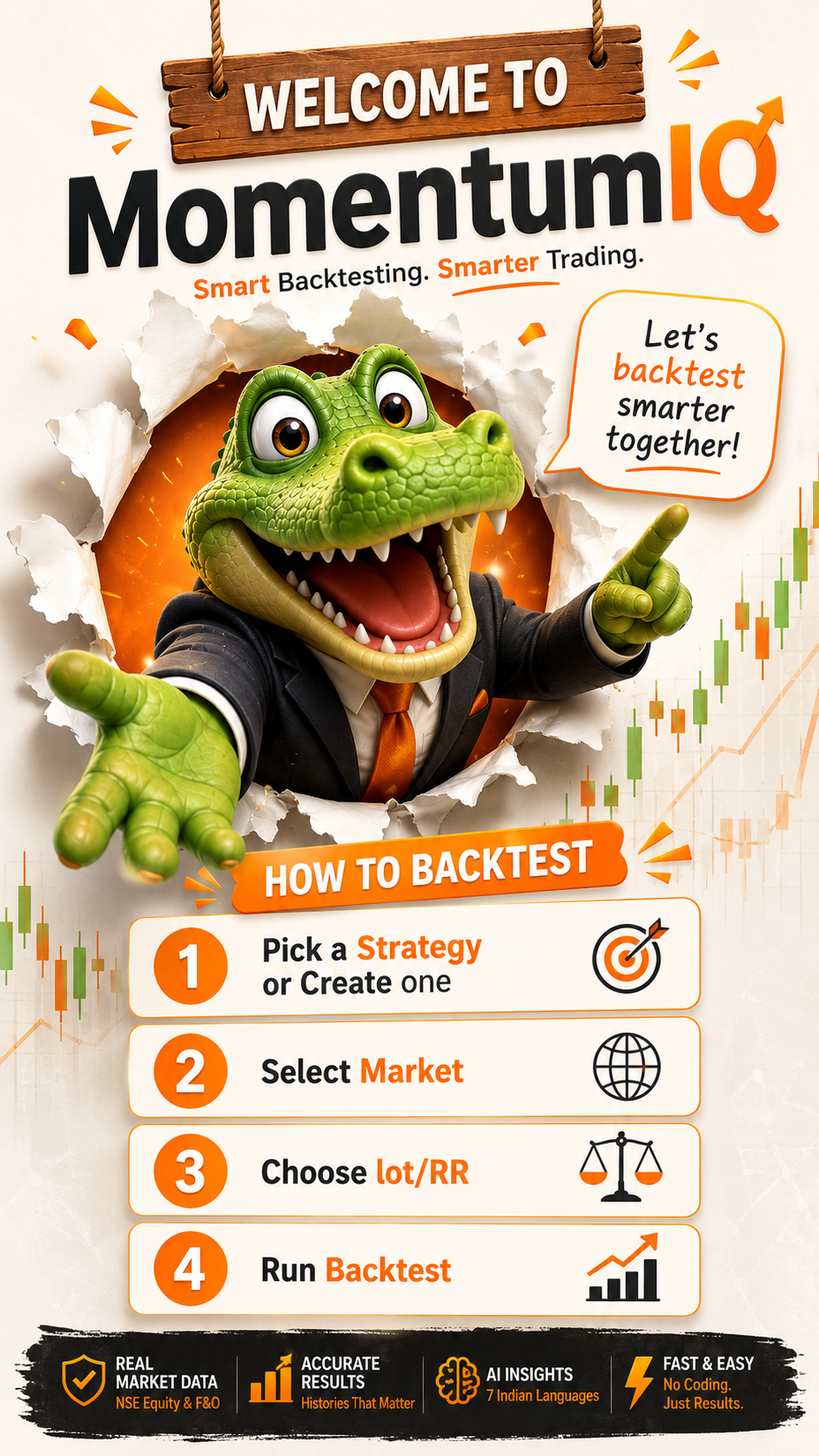
- Choose a strategy template or describe your own in plain language
- Select your symbol (NIFTY 50, BANK NIFTY, or any NSE stock), timeframe, and date range
- Set your capital, position sizing, and brokerage costs
- Run the backtest — results appear in 5–30 seconds
- Review the equity curve, metrics, and trade log
- Compare against the Nifty 50 benchmark
- Iterate — adjust parameters and retest