Beginner★ Very High NSE FitDaily (Expiry)9/10 Popularity
An options-based strategy extremely well-suited for NSE F&O markets. Leverages the unique characteristics of NIFTY and BANK NIFTY weekly options including time decay, volatility cycles, and expiry behaviour.
Complexity
Beginner
Easy to implement
NSE Suitability
Very High
9.2 / 10 score
Timeframe
Daily (Expiry)
Short to medium term
Best For
Options Traders
3–20 days moves
Indicators Used
1
Options Chain
Win Rate (Backtest)
26.9%
Below 50% threshold
Avg Return / Trade
-0.08%
Per trade, after costs
Max Drawdown
-5.6%
Within typical range
Trades / Year
26
Statistically reasonable sample
About the Option Buying Strategy
Option buying is a directional strategy where traders purchase call or put options to profit from anticipated price movements. The strategy captures upside potential with limited downside risk, since the maximum loss is restricted to the premium paid for the option contract.
On NSE, option buying thrives due to high liquidity in index and stock options, particularly in near-the-money strikes where bid-ask spreads remain tight. The strategy works well with NSE's daily expiry contracts, which allow traders to capitalize on intraday volatility without holding overnight risk. Daily expiry options also decay faster, creating opportunities for quick directional plays within a single session.
Traders typically examine the options chain to identify strike prices with suitable risk-reward ratios and reasonable implied volatility levels. The setup involves selecting strikes based on support and resistance levels, then initiating positions when price action aligns with the directional bias. The approach suits traders comfortable with defined risk and clear entry-exit mechanics, making it accessible for those new to derivatives markets.
Who This Strategy Is For
This Beginner strategy suits Options Traders comfortable with a Daily (Expiry) timeframe and holding periods around 3–20 days. It's built for the Options segment on NSE, so it fits traders who can check positions without needing intraday execution speed. Because it uses a small, well-known set of indicators, it's a reasonable starting point if you're new to systematic NSE trading.
Equity Curve (Backtest)
HIGH QUALITY
Tested on: RELIANCE
· 2021-07-05 to 2026-07-15
Total Return
-2.2%
CAGR
-0.5%
Sharpe Ratio
-0.21
Sortino Ratio
-0.32
Calmar Ratio
-0.09
Win Rate
26.9%
NSE Market Fit
9OUT OF 10
Very High Fit
This strategy is well-suited for current NSE market conditions.
Win rate quality Needs Caution
Risk-adjusted return Needs Caution
Drawdown control Excellent
Trade frequency (sample size) Good
Sharpe ratio Needs Caution
Monthly Returns Heatmap
2022
2023
2024
2025
2026
Jan
-0.8%
—
—
-0.7%
—
Feb
-0.5%
-0.5%
—
-1.2%
-0.7%
Mar
+1.9%
—
—
—
-0.9%
Apr
—
—
-0.6%
-0.8%
—
May
—
+0.9%
-0.7%
+1.9%
-0.1%
Jun
-0.1%
—
-0.9%
—
—
Jul
—
—
+1.8%
—
—
Aug
—
—
-1.1%
—
—
Sep
-0.1%
—
—
-0.5%
—
Oct
—
—
-0.9%
+0.9%
—
Nov
+1%
—
—
—
—
Dec
—
+0.9%
-0.6%
—
—
Positive return Negative return
Performance vs Nifty 50
Nifty 50 comparison isn't available for this backtest period yet.
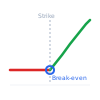
Asymmetric risk setup — limited loss, large potential gain
✕ Avoid When
IV Rank above 60 — paying expensive premiums
Buying options close to expiry — theta decay aggressive
No clear directional view — don't buy straddles randomly
Around events if you don't know the expected move
Buying very deep OTM — lottery ticket mentality
Risk Management Rules
Risk Per Trade
1.0%
of total capital
Min Capital
₹50,000
Hold Period
3–20 days
Segment
Options
Common Mistakes to Avoid
⚠️ As with any systematic strategy, the most common mistake is deviating from the defined entry/exit rules mid-trade based on emotion rather than the backtested logic.
Full Backtest Report
Backtested on RELIANCE ·
2021-07-05 to 2026-07-15 ·
Capital ₹100,000
Equity Curve
Live tracking coming soon
We're building forward-tested, paper-trade tracking for this strategy so you can see how it performs
on live NSE data — not just historical backtests. Check back soon.
Sample Trade Walkthrough
RELIANCE2024-01-30 · Long
WIN
Entry ₹
₹2,920.00
Stop Loss ₹
₹2,840.00
Target ₹
₹3,100.00
Exit ₹
₹3,095.00
Bought Reliance 2960 CE (Feb monthly expiry, 25 DTE) at ₹45. IV Rank was 22 — cheap premiums. Technical breakout from consolidation confirmed with 2x volume. Delta was 0.42. Reliance moved from ₹2,920 to ₹3,080 in 16 sessions. Option premium rose from ₹45 to ₹142. Exit at ₹142 — 215% gain on premium. Risk was only the ₹45 premium paid — capped loss, unlimited upside.
Strategy Parameters
The exact rules and default values this strategy uses — adjust them when you run a full backtest.
Parameter
Default
Min
Max
Type
Description
delta_target
0.40
0.25
0.60
decimal
Target delta — higher = more directional
dte_entry
20
10
45
integer
Days to expiry at entry
dte_exit
7
3
15
integer
Exit when DTE reaches this (theta decay)
profit_target_pct
50.0
30.0
100.0
decimal
Exit at N% gain on premium
stop_pct
30.0
20.0
50.0
decimal
Exit at N% loss on premium
Frequently Asked Questions
Buy options when: (1) IV Rank is below 30 — premiums are cheap, (2) You have a clear directional view backed by technicals, (3) A known catalyst is coming — results, policy, event, (4) The stock or index is at a key technical level. Avoid buying options in random directions or just because they are "cheap" — cheap options can still go to zero.
Risk only 1–2% of total capital per options trade — because options can go to zero. On a ₹5 lakh account, maximum ₹5,000–₹10,000 per options trade. Most retail traders make the mistake of sizing options trades like equity trades — this leads to large percentage losses when options expire worthless. Consistent small positions with good risk-reward is the key.
For directional trades expecting a move in 3–10 days, buy the nearest monthly expiry (30+ DTE) — not the current week. Weekly options (7 DTE) have aggressive theta decay and require the move to happen quickly. Monthly options give more time and are better for swing trades. Only buy weekly options if you expect the move within 2–3 days with high conviction.
Related Strategies
Looking for alternatives? 0DTE Options Strategy is a similar Intermediate strategy in the same Options category, with Very High NSE suitability.
MomentumIQ is an educational platform for strategy research and backtesting. We do not provide investment advice, recommendations, or tips. All backtest results are hypothetical, based on historical data, and for educational purposes only. Past performance is not indicative of future results. Backtested results may not account for brokerage, slippage, taxes, or other real-world costs. Please consult a SEBI-registered investment advisor before making any investment decisions.
 Navigation